Archive for the 'Miramichi River Report' Category
Giffin Family on the Cains 2011
Wednesday, February 1st, 2012
randy-ben_resize

Hey Keith,
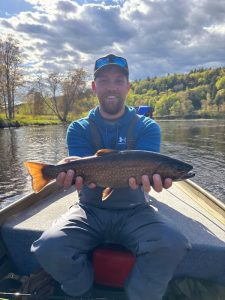
Attached is a picture of my son Ben and my Dad (Randy ) in front of good ol’ Wildcat. The picture was taken last June. The rod Ben is holding is one we built together last spring and he christened it by hooking about a 3-pound sea trout in the run above the camp. Although the fish got away, he got a good fight out of it so it was still a great thrill! Given that we release all these beauties anyway, probably best we didn’t have to handle the fish.
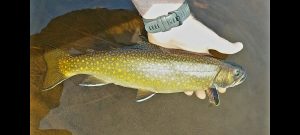
Also attached is a picture Dad took of Ben with the trout on taken from in front the camp. Also, check out the picture of Mark and I trying to fish the lower section below the camp under very high water!! It was pretty much unfishable at that point!!
Incidentally, Ben also hooked his first salmon on that rod in August on the Little SW Miramichi. He got 5 jumps and two nice runs out of what appeared to be about a 10lb salmon before she too got away as I was preparing to tail her. Great way to initiate his new flyrod.
By all accounts, Ben and Dad are looking forward to a return trip to the Cains for more sea-trout fishing in 2012! Hopefully we won’t be pounded by flood water this year like we were last year!

Talk soon!
Geoff
Director, NB Programs
Atlantic Salmon Federation
6 Windwood Court, Quispamsis, NB

Conservation for a Bright Future

Wilson’s Miramichi River Report Jan 26th
Thursday, January 26th, 2012

january-26-2012
The River is now frozen solid . The water is still an ideal height so with any luck we will get a good blanket of snow to help keep our water table up as spring approaches . Looks like 20-30 cm’s coming tomorrow .

High Economic Value of Wild Atlantic Salmon Confirmed by Report
Tuesday, January 10th, 2012

St. Andrews… Gardner Pinfold Consulting Economists Ltd. of Halifax concludes that wild Atlantic salmon were worth $255 million and supported 3,872 full time equivalent (FTE) jobs in eastern Canada in 2010. The firm’s study confirms that Canadians hold a special place in their hearts, and pocketbooks, for restoration of this iconic species.

The Gardner Pinfold evaluation includes a gross domestic product value of $150 million relating to activities such as recreational and First Nation fishing, tourism, education and spending by governments, universities and non- government organizations. In addition, Atlantic Canadians and Quebecers are willing to contribute tax dollars to support successful restoration programs that would cost up to $105 million annually to ensure that wild Atlantic salmon continue to exist and contribute to ecosystem integrity.
(more…)

Wilson’s Miramichi Report For January 4th
Wednesday, January 4th, 2012

jan-4th-2012_resize
The Miramichi River in the McNamee area has been frozen in a couple of times but with the mild winter and very little snow it remains open as of today . You might be able to see from the picture that there are high banks of ice along the shore at Dudley Pool after a warm rain last week caused the ice to run again . This is not unusual in the grand scope of things to have the river freeze in and thaw out several times over winter . As with anytime of the year it is always nice to see a good height of water . The weather is supposed to stay cold for a while now so I expect within a few days we will see things tighten up once again . Only 102 days till we are back fishing .

Remembering Wilf
Tuesday, January 3rd, 2012

Bill Taylor Wilf CarterRemembering Wilf
Bill Taylor
June 11th, 2009

On Monday, February 1, 1988, shortly after 9:00 a.m., I spoke with Dr. Wilfred Carter for the first time, his title back then as head of the Atlantic Salmon Federation was Executive Vice President, and I was calling to apply for a job. My wife, Suzanne, and I were living in New Glasgow, Nova Scotia, and we had read in Saturday’s Halifax Chronicle Herald that ASF was looking for a person to fill a new position-Manager, Affiliate and Public Information Services.

I remember the exact date, because on Saturday we had celebrated my 27th birthday.

Dr. Carter took my call, but politely advised me that he already had a person in mind for the position. He also told me he had not yet made the person an offer and I was able to talk him into at least meeting with me the next day. The rest, as they say, is history.

At that time, next to Suzanne, I had two passions in life, hockey, and Atlantic salmon fishing. Dr. Carter was one of my heroes, right alongside Lee Wulff, Bobby Orr and Gordie Howe.

I clearly recall that Tuesday morning interview in Dr. Carter’s office. To say I was a little nervous would be an understatement. There I was at ASF’s International Headquarters in Chamcook, New Brunswick, surrounded by handsome salmon sculptures, framed antique flies, and historic Pleissner prints, about to meet a man whom I had long admired and attempt to convince him to hire me. Dr. Carter was tall and strong, with a firm handshake, bushy red hair, and even bushier red eyebrows below which twinkled two friendly steel blue eyes.

Dr. Carter smiled, welcomed me into his office and immediately put me at ease as we talked salmon conservation and fishing for nearly three hours. He told me about the job and the important work that needed to be done coordinating the activities of ASF’s 7 provincial and state councils and over 100 affiliate groups. Dr. Carter strongly believed that for ASF to have success, its conservation efforts and policies had to be in step with those of the grassroots salmon conservationists. As he explained to me more than 21 years ago, and I can hear him now as if it was just yesterday, the government decision makers cared little about the whims of a few wealthy salmon anglers living in New York, Toronto, Boston or Montreal. Government laws and policies were then, as they are today, influenced by the views and concerns of the tens of thousands of salmon anglers, guides, outfitters, and men and women living along the salmon rivers of the Quebec North Shore, Gaspé, New Brunswick, Nova Scotia, Prince Edward Island, Maine and Newfoundland and Labrador. To achieve its salmon conservation goals, ASF needed to be clear that it was speaking on behalf of the people who voted for, and sometimes against, the politicians.

I must have made an impression because to my pleasant surprise, I was hired the next day and soon began my career with ASF and my friendship with Dr. Carter. Suzanne and I moved to St. Andrews and bought our first house overlooking the picturesque Bay of Fundy and right across the street from the Carters.

Dr. Carter and his wife, Pauline would become the best of friends with Suzanne and I as we shared celebrated holidays, the births of our daughters, school graduations and our families comforted each other during sickness and difficult times.

On our first fishing trip together, Dr. Carter took me and a few other close friends to his comfortable little camp, Grande Fourche, on the York River. That first evening, fishing with Dr. Carter at my side, pointing out the best taking lies in the pool, I hooked my first Gaspé salmon, a spirited 12-pound hen fresh from the sea. It was like scoring a seventh-game play-off goal on a pass from Wayne Gretzky.

Later that same trip, in the same pool, after Dr. Carter and I had spent a full morning casting an assortment of wet and dry flies over every inch of the best taking water, he confidently announced there weren’t any salmon left in the pool and that he was going back to camp to open the bar. I pleaded for a little more time, tied on a Green Highlander and on the next cast hooked a very big fish that thrashed the pool into a froth before tearing off down a series of rapids and breaking off. Dr. Carter didn’t say a word and it almost seemed he wasn’t as pleased as I was about my good luck. He suggested I join him back at the camp for a cold beer, to which I once again delicately asked for a couple of minutes to make a few more casts. He shook his head, but agreed. I tied on another Green Highlander and promptly hooked another salmon, smaller than the first, but still a fine, bright 15-pounder that we safely landed. Not wanting to press my luck, I agreed to join Dr. Carter back at his camp where we opened the bar and waited for our friends, John Swan, Dr. Tom Taylor, Jack Fenety, and Pierre Lutz to join us. I was quite pleased with myself, barely able to suppress my grin as our friends returned. I did my best to play it cool. Dr. Carter had barely said two words to me since we’d left the river and I was a little worried that maybe he wasn’t thrilled about me having proved him wrong. Actually I was wrong, as it turned out he was anxious to share our morning success with our friends. After all were assembled, Dr. Carter proudly told our fish story, more pleased than if he had hooked the salmon himself, and announcing that if he and I were going to be friends and continue to fish together that I would have to stop calling him Dr. Carter and start calling him Wilf. I couldn’t hold my smile any longer.

Wilf and I spent many happy days together fishing the Miramichi, Restigouche, Kedgwick, Upsalquitch, Matapedia, Margaree and his beloved Gaspé rivers. He introduced me to the Grand Cascapedia where one memorable August evening as the guests of Francis Goelet at Tracadie, we each released a huge salmon at Frazier’s Pool with the incomparable Claudie Harrison as our guide. Sitting on the old porch at Tracadie

that evening, looking down the magnificent Grand Cascapedia River, a view Wilf told me many times was his favorite, sharing salmon stories with dear friends and basking in the afterglow of good single malt and two beautiful salmon carefully released was, as they say, as good as it gets.

Another time I remember Wilf and I driving the long way home following a few days of fishing at Grand Fourche. Driving through New Carlise, Wilf asked that we stop to visit an old friend who wasn’t well. We’d already been driving four hours with another seven still to go and I wasn’t thrilled about a detour, but what could I say? We stopped for a couple of hours, Wilf sharing stories en français with an elderly gentleman who, as it turned out, was a retired commercial salmon fisherman and someone with whom Wilf had a long running feud. But the visit was pure Wilf; he treated everyone with compassion and respect. Sadly, I later learned the man succumbed a few weeks after our visit; I can only think he died a happier man because of the closure provided by Wilf’s unexpected display of friendship.

Last summer, Wilf and I and two friends spent three days as the guests of Fred Eaton at the Ristigouche Salmon Club. It was mid-August, the river was high and dirty following a heavy rain and there were few fish in our pools, but we didn’t care. We were fishing together. Wilf, as was often the case on our fishing adventures, ended up high rod for the trip. Each night we’d gather around the great stone fireplace in the historic old club that Wilf’s brother, Al, had managed for so many years and we’d share our day’s fishing stories. I had never seen Wilf happier; even though he had, I am sure, caught well over one thousand salmon, the fish he hooked, battled and released on that trip gave him as much pleasure as the very first salmon he hooked as a ten-year-old boy while poaching a private pool on the Dartmouth River more than 70 years ago.

Wilf had been retired seven years when I was elected President by the Directors of ASF in the fall of 1996. I was fortunate that he took me under his wing and shared with me the many secrets he had learned about conservation, fundraising, diplomacy, and business. He maintained an office at ASF until his death on March 18, 2009 where, long after retirement, he continued to help ASF and me in every way he could. He co-chaired ASF’s International and Government Affairs Committee until May 2008, providing sage advice and counsel on difficult international salmon conservation issues. Whenever I needed thoughtful advice, a second opinion, or just someone to talk to, Wilf was always there. We spent hundreds of hours talking salmon conservation and fishing in his office, just as we did on our very first meeting on February 1, 1988.

Wilf did it all for ASF during his 20 years of leadership. He was ASF’s chief spokesman, advocate, biologist, and diplomat. He did more for wild Atlantic salmon and ASF during his lifetime than anyone, but he would be the last person on Earth to make this claim. With Wilf at the helm, ASF grew from a small association of salmon anglers into a world renowned and widely respected international conservation organization. As ASF grew, Wilf took on more and more responsibility, including raising the significant amount of money needed to support ASF’s conservation, research, education and public awareness activities. Wilf was the consummate fundraiser. The best advice I ever received about fundraising was something our dear friend Joe Cullman had shared with Wilf 40 years earlier-successful fundraising is all about relationships, people give to people.

That is the thing that I will remember most about Wilf. Relationships were important to him. People mattered to him, his family, his friends, his colleagues, the guides he fished with, the people he met on the river, even his adversaries like the elderly commercial salmon fisherman we stopped to visit in New Carlisle. When you talked with Wilf, whether in the boardroom or on the river, time stood still. He engaged you in thoughtful conversation and he listened to you. He cared about what you were thinking and even if he didn’t agree with you he respected your opinion and your right to express it. No matter how busy he was he always had time to talk, to listen and to help a friend. Wilf cared deeply about the people in his life and we cared deeply about him. We will never forget him.

Bill Taylor is President of ASF.
Reprinted with permission.
Original Article:
http://www.asf.ca/articles.php?id=21

Cains River Enhancement 2011
Wednesday, December 14th, 2011

Cains River EnhancementFriends of the Cains River – on 2/7 of this year I sent an e-mail to the addresses that I had for people directly associated with the Cains River. Based on Mark Hambrook’s opinion that one of the very best things that we can do for the Cains River salmon run is to remove beaver dams and beavers from the streams feeding the river, we set out to raise some extra money for the MSA to do some of this work. According to Mark removing beaver dams provides fall spawning habitat – the salmon ascend the larger Cains feeder streams for some distance to spawn – and these same streams provide thermal buffering and canopy protection for parr in the summer.

Thanks to some generous donations from camp owners, club members, individuals, and outfitters we raised $10,400, and that made this project possible. Jenny Reid, a biologist working for the MSA, has prepared the attached report reviewing the work that was undertaken this year. In all some 60 miles of streams were surveyed for beaver dams, and 88 active and abandoned dams were either completely removed or notched to provide salmon passage. Salmon were observed moving up through these newly created passages to reach spawning areas. To me this is both exciting and rewarding. The last day of the salmon season this year was preceded by an all night rain, and we witnessed an excellent push of salmon moving up the Cains. It was a wonderful sight to see these great fish rolling and jumping on their way up this incredibly beautiful river, and it made me happy to think that we are doing something concrete to help it all continue.

Cains River Salmon EnhancementIf you have any questions about the work that was done I’m sure that Jenny or Mark will be happy to help you. I have copied them both on this so their e-mail addresses are there if you need them. Some time after the MSA Boston dinner I’ll send around a financial update on the project. We received some donations from people that I don’t know and for whom I don’t have e-mail addresses. Perhaps some of you can help me get in touch with these folks so that I can thank them. I’ve asked Mark and Jenny for an update on expenses versus revenue, as well as a list of what we should aim to accomplish next year. I’m sure that, at the least, more of the same efforts to free these streams of dams and to thin out the population of beavers should be undertaken, probably annually.

There is one other aspect to this project, and that is that the MSA netted 10 wild broodstock fish from Black Brook’s Admiral Pool – thank you Black Brook – spawned them out successfully in late October, and will introduce their fry back to the lower Cains early next summer. The scale of that project too could potentially be accelerated as the parr density on the lower Cains has been determined to be less than ideal. This effort was paid for out of the MSA’s general budget.

Thanks to everyone who donated to this project. Enjoy the holidays, and please consider continuing or beginning your financial support for this Cains River enhancement project in 2012.

Brad Burns

P.S. I’ve had a number of folks offer to make a contribution and ask if I would keep them updated on the work. Someone commented to an e-mail last year that more than just the camp owners should contribute. That would be great. Please help spread the word and forward this e-mail to anyone you know who loves the Cains and would have a genuine interest in helping with this project. If they would send me their e-mail address I’ll add them to future distributions.

Download the Cains River Project Report in .pdf

CD Clarke Sportsmans Artist
Thursday, December 8th, 2011

big-murphy-cd-clarke

Big Murphy Pool
By: CD Clarke

Original watercolors, oils and limited addition prints of the great places and the great moments in the world of shooting and fishing. Commission a painting of your favorite pool or grouse cover. The perfect Holiday gift too.
(more…)

Journey Into Climate
Sunday, November 27th, 2011

journey-into-climate-cover

Journey Into Climate
By: Paul Andrew Mayewski
Michael Cope Morrison


The adventure and excitement behind climate research in the polar regions and the world’s high mountains.

In thIs collectIon of adventure stories and restored period photos, authors Paul Andrew Mayewski and Michael Cope Morrison tell their personal experiences going to some of the Earth’s most remote and challenging places, the scientific discoveries they made there, and the journey that they, and the scientific community, made from a “gradualist” viewpoint—thinking that humanity was an inconsequential observer in a slowly changing climate—to the realization that we are deeply and irrevocably involved in the short- and long-term fate of a temperamental climate capable of dramatic changes in a matter of only a few years. They also tell of discovering the worldwide reach of industrial emissions; their effects on climate, civilizations, ecosystems, and our individual quality of life; the remarkable success of the Clean Air Act and the Montreal Protocols; and how some of the effects can clear up in weeks or months—and others only over centuries.
(more…)

Topher Browne – Atlantic Salmon Magic
Monday, November 21st, 2011

topher-browne

Atlantic Salmon Magic
By: Topher Browne

Atlantic Salmon Magic and a smaller companion volume called 100 Best Flies for Atlantic Salmon are the most complete books on the subject in a generation. Both are by Topher Browne of Portland, Maine, a lifelong salmon devotee and acclaimed spey caster. The writing and graphics are extraordinary.

The new titles are part of the award-winning “Masters on the Fly” series by Wild River Press, featuring virtuoso anglers sharing their enthusiasm for, experience with, and hard-won expertise in pursuit of their favorite game fish.

The two salmon books come fresh in the wake of national recognition for A Passion for Tarpon by Andy Mill, which Wild River published one year ago. At BookExpo America in New York in May 2011, Mill’s tarpon book received four awards for excellence, including gold medal Benjamin Franklin Book of the Year awards in two categories—recreation/sports and regional—from the Independent Book Publishers Association, the country’s largest organization of 3,200 independent publishers. Previously, no fishing book had ever achieved this distinction.

Nearly 500 pages with hundreds of stunning color photos and original illustrations, Atlantic Salmon Magic is destined to become a classic. The book is an invaluable guide to everything about Salmo salar, the legendary leaper, celebrated since the time of the Romans. A rich literary and visual feast, this impressive new title from Wild River Press is an absolute must for the avid salmon angler.
(more…)

John Swan – A Painter’s Life
Thursday, November 10th, 2011

john-swan-painters-life

A Painter’s Life
By: John Swan
Images From An American Artist
Foreword by Charles Gaines

Just released, covering the artists career in painting with 100 images in full color, text, personal notes from the artist, and a forward by Charles Gaines. A beautiful anthology, representing John Swan’s broad range of style and subject matter in both oil and watercolor.
(more…)

Wilson’s Miramichi Region News
Wednesday, November 9th, 2011

Hello friends of the St. John River!
Please find attached an invitation to an upcoming series of sessions in communities along the St. John River. CCNB Action, Canadian Rivers Institute and WWF Canada, along with local community hosts, invite you to be a part of a discussion about the newly released “State of the Environment” report of the St. John River, to share your knowledge of the river and to connect with each other to make future positive changes throughout the system.

Sessions will be held in:
Hammond River: Hammond River Angling Association, 10 Porter Road, Nauwigewauk 7:00 pm
St. Mary’s First Nation: Cultural Centre, 35 Dedham St. Fredericton 12:00 pm
Gagetown: Gagetown Recreation Centre, 38 Mill Rd 7:00 pm
Tobique First Nation: Bingo Hall, 24 Main St. 12:00 pm
Fredericton: Renaissance College, 811 Charlotte St. 7:00 pm
Woodstock: Connell House, 128 Connell St. 7:00 pm
Florenceville: Florenceville Inn, 239 Burnham Rd. 7:00 pm
Edmundston: 6th floor Pavillon Simon-Larouche, 185 boulevard Herbert, Université de Moncton, campus d’Edmundston) 7:00 pm

All are welcome, please feel free to distribute this invitation. Please RSVP so we have an idea of attendance.
Looking forward to a great discusscussion about the St. John River!

Stephanie
Stephanie Merrill
Coordinator/Coordonnatrice
Freshwater Protection Programme de protection des eaux douces
CCNB Action/Action CCNB
180 rue St. John Street
Fredericton, NB E3B 4A9
CANADA
Phone / Téléphone: 506.458.8747
Fax / Télécopieur: 506.458.1047
Email / Courriel: water@ccnbaction.ca
www.facebook.com/ccnbaction

The Grand Cascapedia River, A History: Vol II
Thursday, November 3rd, 2011

hoagy-cascapedia-300

The Grand Cascapedia River
A History: Volume II
By: Hoagy Carmichael
Available June 1st, 2012
Reserve your copy now.

The second and final volume of the award-winning history of The Grand Cascapedia River. In its eleven chapters, Volume II covers the history of the river’s eight camps, and the sports who fished out of them, from the mid-1930’s through (more…)

Something for the deer hunters to drool over
Tuesday, November 1st, 2011

OLYMPUS DIGITAL CAMERA
Hi Keith,
Here’s a little more detail on the deer and a couple more pictures…

I figured you’d appreciate this deer story as you’re getting
into full deer mode. So I’ve been an avid hunter for many years and
I’m basically obsessed with deer. It’s only been in the past couple
years that I really wanted to get close, which of course means
bowhunting. Getting close to any deer is a challenge, let alone a
buck, and let alone a big buck. So that’s what I dedicated my time
to….trying to figure out the big ones. Where the travel and why,
where they eat, bed, how to cover my scent, wind, etc etc. I didn’t
figure it all out but I did spend countless hours in the woods over
the past two years, in all 4 seasons, observing and thinking and
scouting. I suppose that helped me figure out enough. It all came to
the moment on Tuesday night when I saw the big guy coming right
towards my stand, just as I planned (but just as we all plan). I
practice with my bow a lot and at all different yardages. One thing’s
for sure, you can’t practice for how heavy your heart beats. It wasn’t
beating fast, just so heavy that it made my whole body move…not
something you want when getting ready to let an arrow go. He came in
and turned broadside at 20 yds, every bowhunter’s dream. So I took my
chance and hit him in the boiler room….almost. I hit about 3 inches
too far forward of where I aimed and got him in the shoulder blade,
tragic. I saw the arrow sticking out as he ran back in exactly the
same direction he came. I could see that it was in a little ways and
could see he was hurting a bit as he crashed through some deadfalls
but I just hoped it made it in to the vitals. This was at 5:45. So I
gave him a bit extra time and waited till 6:30, checking my watch
every 35 seconds of course. I wanted to give him enough time, but also
give myself enough time to track him before it got too dark. So I
followed the tracks, but there was no blood which scared the bejeezuz
out of me. I followed his tracks for 130 yards and just wanted to race
ahead and start looking all over for him. Some wise advice from fellow
bowhunters stopped me from doing that. I didn’t go further than the
last mark I knew for sure was him, and I ribboned everything. I had to
go back and forth a bit and it seemed he had either stopped running
and walked away or was somewhere nearby. My bow was ready just in
case. So from his last track that I could see I took a real good scan
around me. Sure enough, there he was, 15 yards to my left laying down,
neck and head up looking at me. Shit. Quick decision: he’s hurting but
not hurting enough…get another arrow into him. So I instantly
manoeuvered a bit to get a shooting lane and drew, and fired. Anyway,
he got up and took off but was hurting bad. I waited 20 mins until
7:05, just before it got too dark to find him, and I followed his
trail, blood this time. I got to within 40 yards and again I could see
his head up looking at me but I knew it was over. I knelt down 40
yards away, wanted to keep my distance not to push him, and watched as
his head slowly got lower and lower and it slowly got dark. I waited
an hour. Then went up and he was dead. Tough tough buck. It was pretty
hard basically being face to face as he died, he was the king of those
woods and I paid my respects when I got to him. I was happy and
excited, a bit sad, relieved, you name it. It turns out my first shot
did get in there far enough and got to his vitals but all the bleeding
was internal and the arrow pretty much plugged the hole, that’s why
there wasn’t much of a blood trail at the start. So, that’s the story,
here’s the pictures, enjoy and very best of luck getting your deer
this year!
Nathan
> <((((º>

Nepisiquit River Monster Salmon
Sunday, October 30th, 2011

OLYMPUS DIGITAL CAMERA
Hi Keith,

I wasn’t able to get out much this year, however, the times I did proved to be the best salmon fishing I’ve ever had and it turned out to be my personal best. I “limited out” almost everytime I went out. Before the season started, I had told my fishing buddies that I had yet to hook a “hookbill”. As much fishing as I had done in the past, I had landed some large females, but the large males always eluded me. Well, on October 14, 2011, my dream came true and landed the fish of a lifetime. This guy was hooked on the Nepisiguit River, just North of Bathurst. This river is not well known outside the local salmon aficionados, but man, what a river! I’m still in shell shock over this one, looks like it will take me all Winter to digest the whole ordeal as I relive it in my mind again and again…………

Tight lines

Chris Leger

Atlantic Salmon Reports
Monday, October 24th, 2011

marty-stewart-_resize
Hey Keith,
I fished up in New Brunswick with Marty Stewart October 1 through 7. We fished the Little Southwest, Dungarvin, Renous and Northwest. I never saw as many fish in all rivers as this year and I have fished up there two or three times each year since 1993. I landed fish in each river, raising between 25 and 30 fish in six days and landing 15 even though the weather was brutal, some days 20-40 mph winds. Biggest was about 17 lbs. Most were taken on Cascade flies (you can find the patterns on you tube tied by Davie McPhail). I expect spring fishing next year will be awesome. I can’t wait.

James Specter, DDS.

Shavertown, PA.

Older Entries »